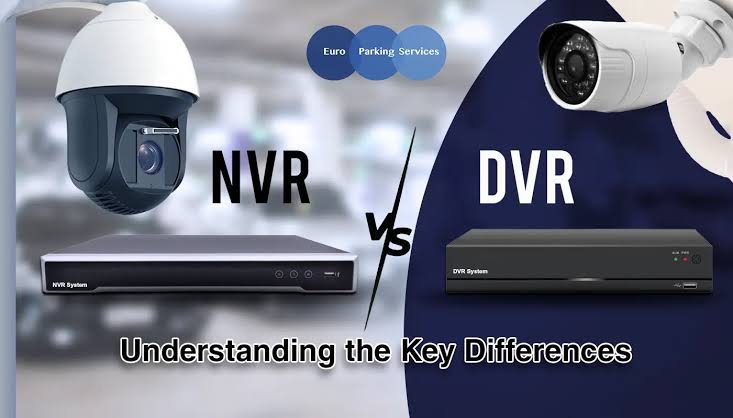
Difference Between DVR and NVR
When choosing a CCTV security system, one of the biggest decisions you’ll face is whether to use a DVR (Digital Video Recorder) or an NVR (Network Video Recorder). Both devices record video footage from security cameras, but they work in very different ways.
If you’re setting up a home security system, protecting a business, or upgrading your existing CCTV installation, understanding the difference between DVR and NVR will help you make the right investment.
In this guide, we’ll explain how DVRs and NVRs work, compare their features, and help you determine which option best suits your security needs.
What Is a DVR?
A Digital Video Recorder (DVR) records video from analogue CCTV cameras, offering several benefits of CCTV camera installation, including reliable video storage, easy monitoring, and improved security management.
The cameras capture video and send the signal through coaxial cables to the DVR, where the footage is processed, compressed, stored, and managed. DVR systems have been used for many years because they are reliable, affordable, and easy to install for small to medium-sized properties.
How a DVR Works
- Analogue cameras capture video.
- Video travels through a coaxial cable.
- DVR processes and compresses the footage.
- Footage is stored on an internal hard drive.
- Users can view recordings locally or remotely through compatible software.
What Is an NVR?
A Network Video Recorder (NVR) is designed to work with IP (Internet Protocol) cameras. Unlike analogue cameras, IP cameras process video internally before sending digital footage to the NVR through an Ethernet network.
This makes NVR systems more flexible, easier to expand, and capable of supporting higher-resolution cameras.
How an NVR Works
- IP cameras capture and process video.
- Digital footage travels through Ethernet cables or Wi-Fi.
- NVR stores the video without needing to process analogue signals.
- Users access live and recorded footage through network-connected devices.
DVR and NVR: Quick Comparison
| Feature | DVR | NVR |
|---|---|---|
| Camera Type | Analogue Cameras | IP Cameras |
| Video Quality | Good (typically up to 1080p) | Excellent (2MP to 12MP and beyond) |
| Cable Type | Coaxial Cable | Ethernet (Cat5e/Cat6) |
| Power Supply | Separate Power Cable | PoE can provide power and data together |
| Installation | More cabling required | Cleaner and simpler with PoE |
| Remote Access | Available | More advanced features |
| Scalability | Limited | Highly scalable |
| Smart Features | Basic | Advanced AI capabilities |
| Cost | Lower | Higher initial investment |
Image Quality: Which Is Better?
One of the biggest differences between DVR and NVR systems is video quality.
DVR Systems
Traditional DVR systems commonly support:
- 720p
- 1080p
- HD analogue cameras
While modern HD-over-Coax systems have improved significantly, image quality is still generally lower than IP camera systems.
NVR Systems
NVRs support much higher resolutions, including:
- 2MP
- 4MP
- 5MP
- 8MP (4K)
- 12MP and higher
This provides sharper images, better facial recognition, and clearer licence plate capture.
Installation Differences
Installation is another major factor.
DVR Installation
DVR systems require:
- Coaxial cable for video
- Separate power cable for each camera
This means more wiring and slightly longer installation times.
NVR Installation
Most NVR systems use Power over Ethernet (PoE). A single Ethernet cable carries:
- Video
- Power
- Data
This reduces cable clutter and simplifies installation.
Storage and Recording
Both DVR and NVR systems store recordings on internal hard drives. However, NVR systems often provide:
- Better video compression
- Larger storage capacities
- Cloud integration
- Easier backup options
Many modern NVRs also support multiple hard drives for extended recording periods.
Remote Viewing
Today’s security systems allow you to monitor your property from anywhere. Both DVR and NVR systems usually offer:
- Mobile apps
- Desktop software
- Browser access
- Motion notifications
However, NVR platforms generally provide smoother remote viewing and additional smart monitoring features.
Smart Features
Modern IP cameras connected to NVRs often include intelligent analytics such as:
- Human detection
- Vehicle detection
- Facial recognition
- Line crossing alerts
- Intrusion detection
- AI-powered motion filtering
Most DVR systems provide only basic motion detection. If advanced security features matter to you, an NVR system is the better choice.
Reliability
Both systems are reliable when installed correctly.
DVR Advantages
- Proven technology
- Stable analogue connections
- Less affected by network issues
NVR Advantages
- Higher flexibility
- Better future compatibility
- Easier upgrades
- Improved video management
Cost Comparison
Budget often influences the decision.
DVR Systems
Typically offer:
- Lower equipment costs
- Affordable cameras
- Budget-friendly upgrades
Ideal for homeowners and small businesses with basic security requirements.
NVR Systems
Usually require:
- IP cameras
- Network switches (if needed)
- Higher initial investment
Although more expensive, NVR systems deliver better long-term value through superior image quality and smart features.
Which One Should You Choose?
Choose a DVR if:
- You have a limited budget.
- You’re upgrading an existing analogue CCTV system.
- You only need basic surveillance.
- Your property is relatively small.
Choose an NVR if:
- You want the best image quality.
- You’re installing a new security system.
- You need AI-powered security features.
- You expect to expand your CCTV system in the future.
- You prefer easier installation with PoE cameras.
Yes, but it usually requires replacing your analogue cameras with IP cameras. Some hybrid recorders support both analogue and IP cameras, allowing gradual upgrades without replacing the entire system at once.
FAQs
1. Is an NVR better than a DVR?
In most cases, yes. NVR systems provide higher video quality, advanced smart features, easier installation, and better scalability.
2. Does a DVR work with IP cameras?
No. Standard DVRs are designed for analogue cameras. IP cameras require an NVR or a compatible hybrid recorder.
3. Which system is more affordable?
DVR systems generally have a lower upfront cost, making them suitable for budget-conscious installations.
4. Do both systems support remote viewing?
Yes. Most modern DVR and NVR systems allow users to monitor live and recorded footage through mobile apps and web browsers.
5. Which system is best for businesses?
For businesses that require high-resolution video, advanced analytics, and future expansion, an NVR system is usually the better investment.
Final Thoughts
The choice between a DVR and an NVR ultimately depends on your budget, existing equipment, and security goals.
If you’re looking for a cost-effective solution for a small home or office, a DVR system can provide dependable performance. However, if you want crystal-clear video, intelligent security features, and a system that can grow with your needs, an NVR is the smarter long-term investment.
As surveillance technology continues to evolve, IP camera systems paired with NVRs are becoming the preferred choice for modern homes, businesses, warehouses, and commercial properties. By understanding the differences between DVR and NVR, you can confidently choose a CCTV recording solution that offers the right balance of performance, reliability, and value for your property.