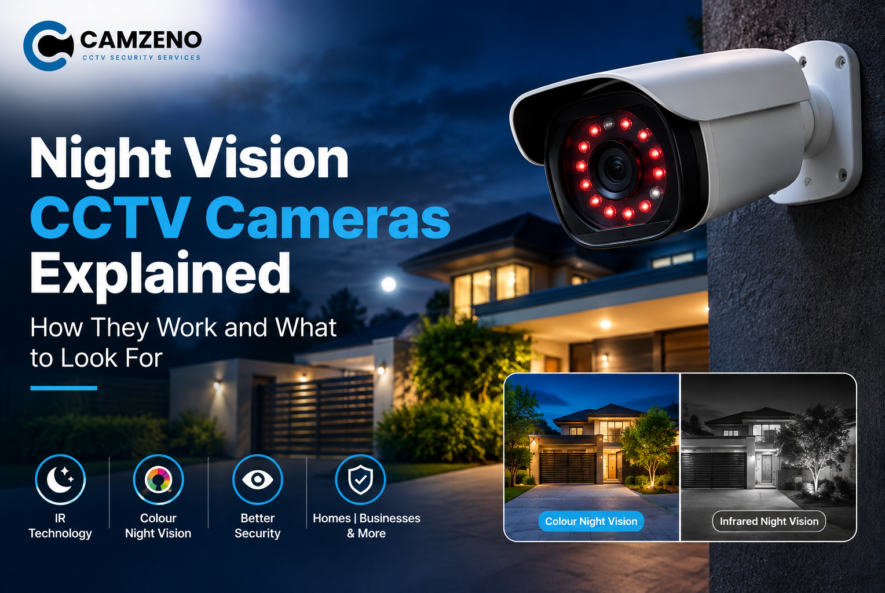
Night Vision CCTV Cameras Explained
When the sun goes down, your CCTV system should not stop protecting your property. Night vision CCTV cameras capture useful footage in low light and complete darkness, making them an important choice for homes, businesses, warehouses, offices, and outdoor areas.
But how does night vision actually work? Is every night vision camera the same? And what should you check before buying one? This guide explains everything you need to know in simple terms.
What Is a Night Vision CCTV Camera?
A night vision CCTV camera is a security camera designed to record images when there is little or no visible light. Most traditional Night Vision CCTV cameras need sufficient light to produce a clear colour image. Night vision models use technologies such as infrared (IR) LEDs, low-light sensors, or colour night vision to continue monitoring after dark.
Depending on the camera, nighttime footage may appear:
- Black and white
- Full colour
- Colour with additional lighting
- A combination of colour and infrared modes
The right option depends on the lighting conditions and security requirements of your property.
How Does CCTV Night Vision Work?
The most common night vision technology uses infrared light. IR LEDs around the camera lens emit infrared light that is generally invisible to the human eye. The camera’s image sensor detects this light and converts it into an image.
The basic process is simple:
Dark environment → IR LEDs activate → Infrared light illuminates the area → Camera sensor captures the scene → Footage is displayed
This allows a camera to monitor areas that may appear completely dark to people. Some modern cameras can also use available ambient light, advanced sensors, or integrated white-light LEDs to produce colour footage at night.
Types of Night Vision CCTV Cameras
Not all night vision systems work in the same way. Here are the main types you may come across.
1. Infrared Night Vision Cameras
Infrared cameras are among the most common options for nighttime surveillance. They use IR LEDs to illuminate the scene without requiring visible lighting. When operating in infrared mode, footage is usually displayed in black and white.
Best for:
- Homes
- Offices
- Warehouses
- Parking areas
- Outdoor entrances
- Low-light locations
2. Colour Night Vision Cameras
Colour night vision cameras are designed to retain colour information in low-light conditions. Instead of relying entirely on infrared illumination, these cameras may use highly sensitive image sensors and available ambient light. Colour footage can make it easier to identify details such as clothing, vehicles, and objects. However, performance depends heavily on the amount of available light.
3. Full-Colour Cameras With Built-In Lighting
Some modern cameras include visible white-light LEDs. When the environment becomes dark, the camera can activate its built-in lighting to illuminate the area and capture colour footage. This can provide useful detail while also making the camera more noticeable as a security deterrent.
4. Smart or Hybrid Night Vision
Some advanced cameras automatically switch between different night modes depending on the surrounding conditions.
For example, a camera may:
- Start with colour footage in low light.
- Detect that the scene has become darker.
- Activate infrared illumination.
- Return to colour when sufficient visible light becomes available.
This automatic adjustment can help maintain useful footage throughout the night.
How Far Can a Night Vision Camera See?
One of the most important specifications to check is the night vision CCTV cameras range. A camera might be advertised with a night vision distance of 20m, 30m, 40m, or more. However, this does not necessarily mean you will get the same level of detail throughout that entire distance.
Actual performance can be affected by:
- Camera sensor quality
- Lens type
- IR LED power
- Angle of view
- Weather conditions
- Objects in the scene
- Reflective surfaces
- Ambient lighting
For example, a camera may illuminate a large area but still provide better facial or object detail closer to the camera.
Tip: Don’t choose a camera based only on its advertised night vision distance. Consider the actual area you need to monitor.
What Makes Nighttime CCTV Footage Clear?
Several factors influence the quality of nighttime footage.
Image Sensor
The image sensor plays a major role in low-light performance. A high-quality sensor can capture more useful information when lighting conditions are poor.
Lens
The lens determines how much of the scene the camera can capture and can influence how much light reaches the sensor.
Infrared LEDs
For IR cameras, the number, quality, and positioning of infrared LEDs can affect nighttime illumination.
Resolution
Higher resolution can provide more detail, but resolution alone does not guarantee excellent nighttime footage.
A well-designed camera with a good sensor and suitable lens can outperform a camera that simply advertises a higher resolution.
Camera Placement
Even an excellent night vision camera can produce poor footage if it is installed incorrectly.
Avoid positioning cameras directly toward:
- Bright lights
- Reflective walls
- Glass surfaces
- Strong headlights
- Areas where objects block the lens
Infrared vs Colour Night Vision: What’s the Difference?
The main difference is how the camera produces useful images in darkness.
| Feature | Infrared Night Vision | Colour Night Vision |
|---|---|---|
| Typical footage | Black and white | Colour |
| Works in darkness | Yes | Depends on technology |
| Uses IR | Usually | Not always |
| Visible lighting required | No | Often some light or built-in lighting |
| Identification details | Good | Can provide additional colour information |
| Suitable for | General nighttime monitoring | Situations where colour details matter |
Neither option is automatically suitable for every property. Your choice should depend on lighting conditions, installation location, and the details you need to identify.
Where Should You Install Night Vision CCTV Cameras?
Night vision CCTV cameras are particularly useful in areas where lighting is limited.
- Around Home Entrances – Monitor front doors, back doors, garages, and other entry points after dark.
- Driveways and Parking Areas – A properly positioned camera can help monitor vehicles and activity during nighttime hours.
- Business Premises – Retail stores, offices, and commercial properties can benefit from continuous monitoring outside business hours.
- Warehouses – Large storage areas may have limited lighting, making night vision particularly useful.
- Industrial Areas – Night vision cameras can help monitor entrances, equipment areas, boundaries, and other important zones.
5 Things to Check Before Buying a Night Vision CCTV Camera
Choosing a camera based only on price or resolution can lead to disappointing nighttime performance. Check these specifications first.
- Night Vision Range
Choose a range appropriate for the distance you need to monitor.
- Resolution
Consider 2MP, 4MP, 5MP, 8MP, or other available resolutions according to your surveillance requirements.
- Sensor and Low-Light Performance
A quality image sensor can make a significant difference when there is limited lighting.
- Weather Protection
For outdoor installation, look for appropriate weather-resistant construction and an IP rating suitable for the environment.
- Storage Requirements
Nighttime monitoring can generate many hours of footage. Make sure your DVR/NVR and storage capacity can handle your recording requirements.
Common Night Vision CCTV Cameras Problems
Even a good camera can experience nighttime issues if the system isn’t configured correctly.
- IR light can reflect from nearby walls, windows, or other surfaces and create washed-out footage.
- Small objects close to the lens can become highly visible when infrared LEDs are active.
- A camera pointed toward a bright light source may struggle to produce balanced footage.
- Colour night vision cameras may require more ambient light than expected.
- Installing a short-range camera in a large outdoor area can result in poor coverage.
- Regular cleaning and professional installation can help avoid many of these problems.
Are Night Vision CCTV Cameras Worth It?
For properties that require surveillance after sunset, night vision can be an important feature. A camera that provides useful footage during the day but becomes ineffective after dark leaves a significant gap in surveillance coverage.
The best setup depends on factors such as:
- Property size
- Indoor or outdoor installation
- Available lighting
- Required viewing distance
- Desired image detail
- Storage capacity
- Budget
Instead of simply choosing the camera with the highest resolution or longest advertised range, consider how the entire surveillance system will perform in your actual environment.
FAQs
1. Do night vision CCTV cameras work in complete darkness?
Yes. Cameras with infrared night vision can capture footage in very dark or completely dark environments by using infrared illumination.
2. Are night vision CCTV cameras always black and white?
No. Traditional IR night vision is generally black and white, while some modern cameras can provide colour footage in low-light conditions.
3. How far can CCTV night vision see?
The range varies by camera. Factors such as IR illumination, sensor quality, lens, environment, and camera placement affect actual performance.
4. Is colour night vision better than infrared?
They serve different purposes. Colour night vision can provide additional colour details, while infrared systems can work effectively in very dark environments.
5. Can night vision CCTV cameras be used outdoors?
Yes. Outdoor models are designed for exterior environments, but you should check their weather protection and install them correctly.
6. Why does my CCTV look blurry at night?
Possible causes include dirty lenses, spider webs, reflections, poor positioning, insufficient lighting, or limitations of the camera’s low-light performance.
Final Thoughts
Night vision CCTV cameras help extend security monitoring beyond daylight hours. From infrared cameras for completely dark areas to colour night vision systems for better nighttime identification, there are options for different surveillance needs.
Before choosing a camera, look beyond resolution. Check its night vision technology, sensor quality, illumination range, lens, weather protection, storage requirements, and installation position. With the right combination of camera, lighting, placement, and recording equipment, you can maintain more reliable surveillance throughout the night.