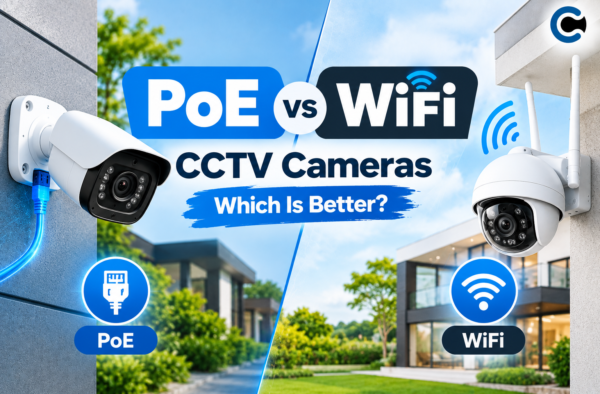
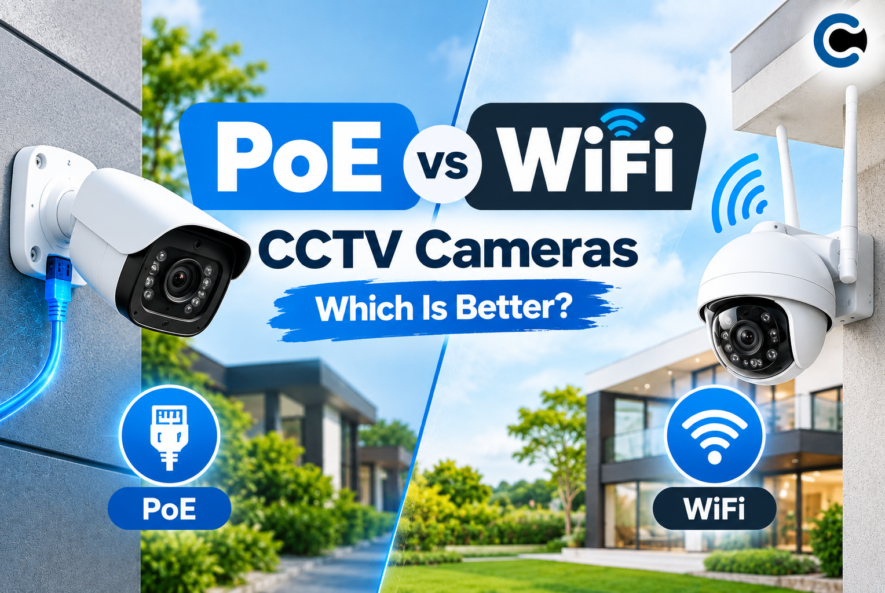
PoE vs WiFi CCTV Cameras
Choosing the right CCTV camera connection can make a big difference in the reliability, installation, and performance of your security system. Two popular options today are PoE CCTV cameras and WiFi CCTV cameras.
Both can provide high-quality video surveillance, remote viewing, and smart security features—but they work differently and suit different environments. So, PoE vs WiFi CCTV cameras: which one should you choose?
What Are PoE CCTV Cameras?
PoE (Power over Ethernet) CCTV cameras use a single Ethernet cable to transmit both power and video/data between the camera and network equipment. A typical PoE setup includes:
- PoE CCTV cameras
- Cat5e or Cat6 Ethernet cables
- PoE switch or PoE NVR
- NVR for recording
- Hard drive for video storage
- Router for remote access
Because the camera receives power and data through the same cable, PoE systems can provide a stable connection without requiring a separate power cable at every camera location.
What Are WiFi CCTV Cameras?
WiFi CCTV cameras connect to your network wirelessly instead of using an Ethernet cable for video transmission. Most WiFi cameras still need a power source, so installation usually involves:
- WiFi CCTV cameras
- Power adapters
- WiFi router
- MicroSD card, NVR, or cloud storage
- Internet connection for remote access
Some models also offer features such as two-way audio, motion detection, smartphone alerts, and AI-based detection.
PoE vs WiFi CCTV: Key Differences
| Feature | PoE CCTV Cameras | WiFi CCTV Cameras |
|---|---|---|
| Connection | Ethernet cable | Wireless WiFi |
| Power | Usually through Ethernet cable | Usually separate power supply |
| Video Stability | Very stable | Depends on WiFi strength |
| Installation | Requires cable installation | Easier in many locations |
| Interference | Low | Can be affected by wireless interference |
| Network Reliability | Generally high | Depends on router and signal |
| Scalability | Easy with PoE switches | Depends on WiFi capacity |
| Best For | Homes, offices, businesses | Homes, apartments, temporary setups |
| Recording | NVR, NAS, SD, etc. | SD, NVR, cloud, depending on model |
| Internet Dependency | Not necessarily for local recording | Not necessarily for local recording, depending on setup |
1. Installation: PoE vs WiFi
Installation is one of the biggest differences. WiFi cameras can be easier to install because you don’t need to run an Ethernet cable back to the NVR or network switch. You generally need a suitable power source and a strong WiFi signal.
PoE cameras require Ethernet cabling. This can take more planning, particularly in an existing building where cables need to pass through walls or ceilings. However, PoE has an important advantage: one Ethernet cable can provide both power and data.
Which is easier?
For a small installation where running cables is difficult, WiFi may be more convenient. For a new construction or professionally installed security system, PoE can provide a clean and structured setup.
2. Connection Stability
When it comes to reliability, the connection method matters. PoE cameras communicate through a wired Ethernet connection. This means they aren’t affected by common wireless problems such as weak WiFi signals, interference, or congestion.
WiFi cameras rely on wireless communication. If a camera is installed far from the router or behind several thick walls, the signal may become weaker. This doesn’t mean WiFi cameras are unreliable. A properly designed WiFi network can support them well. But network coverage should be considered before installation.
3. Power Supply
PoE is particularly convenient because the Ethernet cable can deliver power and network data simultaneously. For example, a PoE NVR or PoE switch can provide power to connected cameras through compatible Ethernet cables.
WiFi cameras generally require a separate power connection. Even though video is transmitted wirelessly, the camera still needs electricity unless it is a battery-powered model. This is an important point that many people overlook: WiFi does not automatically mean completely wireless.
4. Video Quality
Both PoE and WiFi cameras can support high-resolution video, including:
- 2MP
- 4MP
- 5MP
- 8MP and higher
The connection type itself doesn’t determine image quality. Instead, factors such as the camera’s image sensor, lens, bitrate, compression, lighting, and resolution have a major impact on video quality. However, PoE’s wired connection can make it easier to maintain a consistent data connection, particularly when several cameras are recording simultaneously.
5. Remote Viewing
Both systems can support remote viewing when properly configured. With a compatible setup, you can use a smartphone, tablet, or computer to check your cameras remotely. Depending on the system, remote access may allow you to:
- View live footage
- Review recordings
- Receive motion alerts
- Control certain cameras
- Use two-way audio
- Manage camera settings
Remote viewing generally depends on your network configuration and internet connection—not simply whether the camera is PoE or WiFi.
6. Security Considerations
A CCTV system should protect your property without creating unnecessary network vulnerabilities. PoE cameras use physical Ethernet connections, which can reduce dependence on wireless communication.
WiFi cameras, on the other hand, communicate over a wireless network. Proper security practices are therefore important. For either system:
- Use strong passwords.
- Change default login credentials.
- Keep firmware updated.
- Secure your router.
- Use a properly configured network.
- Restrict unnecessary remote access.
- Choose reputable camera manufacturers.
The security of your network and camera configuration is just as important as the camera’s connection type.
7. Storage and Recording
PoE and WiFi cameras can both support different recording methods depending on the model. Common options include:
NVR Recording
An NVR can continuously record footage from compatible network cameras. This is particularly common with PoE CCTV systems.
MicroSD Storage
Some WiFi cameras have built-in MicroSD card support, allowing footage to be stored locally.
Cloud Storage
Certain cameras offer cloud-based recording, usually through a subscription service. When choosing a camera, check exactly where your footage will be stored and how long it will be retained.
8. Which Is Better for a Home?
For homes, the right choice depends on your property and installation requirements.
WiFi CCTV may be suitable if:
- You only need a few cameras.
- Running Ethernet cables is difficult.
- You have strong WiFi coverage.
- You want a simpler installation.
- You need cameras in locations where cabling is inconvenient.
PoE CCTV may be suitable if:
- You want a more permanent security system.
- You need several cameras.
- You want a stable wired connection.
- You are building or renovating your property.
- You want centralized NVR recording.
9. Which Is Better for a Business?
For many businesses, a wired PoE system can be practical because businesses often require multiple cameras and continuous recording. A PoE setup can make it easier to connect cameras to a central NVR while keeping the network organized.
PoE can be especially useful for:
- Offices
- Shops
- Warehouses
- Schools
- Factories
- Commercial buildings
- Large properties
WiFi cameras can still be useful for specific locations where running Ethernet cables is difficult.
PoE vs WiFi CCTV: Pros and Cons
PoE CCTV Cameras
Pros:
- Stable wired connection
- Power and data through one cable
- Suitable for multiple-camera systems
- Less affected by wireless interference
- Well suited to permanent installations
- Centralized recording is easy with an NVR
Cons:
- Ethernet cabling is required
- Installation can take more planning
- Cable installation may increase initial labor costs
WiFi CCTV Cameras
Pros:
- Easier installation in many situations
- Less Ethernet cabling
- Flexible camera placement
- Convenient for small installations
- Useful where cable installation is difficult
Cons:
- Depends on WiFi coverage
- Wireless interference can affect connectivity
- Usually requires a separate power source
- Multiple cameras can place additional demands on the WiFi network
PoE vs WiFi CCTV: Which Should You Choose?
There isn’t one connection type that is perfect for every property. Choose PoE CCTV cameras if you prioritize a stable wired connection, centralized recording, and a permanent security installation.
Choose WiFi CCTV cameras if you prioritize installation flexibility and have reliable WiFi coverage in the areas you want to monitor. For a small home setup, WiFi can be convenient. For larger homes, offices, shops, warehouses, and other properties requiring several cameras, a properly planned PoE system can provide a structured and reliable solution.
FAQs
1. Are PoE cameras better than WiFi cameras?
They serve different installation needs. PoE provides a wired connection, while WiFi offers greater wireless flexibility.
2. Do PoE cameras need WiFi?
No. PoE cameras can communicate through Ethernet. WiFi or internet access may still be required for certain remote-viewing configurations.
3. Do WiFi CCTV cameras need power cables?
Most WiFi cameras require a power source even though video is transmitted wirelessly. Battery-powered models are an exception.
4. Can PoE and WiFi cameras be used together?
Yes, depending on the NVR, network, and camera compatibility. The system should be planned to ensure all cameras can be properly connected and recorded.
5. Which CCTV is better for outdoor use?
Both can work outdoors if the camera is designed for outdoor conditions. Look for appropriate weather protection, night vision, and suitable mounting options.
6. Is PoE CCTV more reliable than WiFi?
A wired PoE connection is generally less affected by wireless signal issues. WiFi systems can also be reliable when they have strong coverage and a properly configured network.
Final Thoughts
The choice between PoE vs WiFi CCTV cameras ultimately comes down to your property’s layout, number of cameras, network infrastructure, installation requirements, and recording needs. PoE offers the advantages of a wired connection with power and data delivered through one Ethernet cable. WiFi cameras provide greater flexibility where running cables isn’t practical.
Before buying, don’t focus only on the camera’s resolution. Consider connection stability, power requirements, storage, coverage, installation, and future expansion. A properly planned CCTV system will give you more dependable surveillance than simply choosing the newest or highest-resolution camera.