Types of CCTV Cameras
CCTV cameras have become an important part of modern security for homes, offices, shops, warehouses, schools, and other properties. But with so many camera designs and features available, choosing the right option can feel confusing.
From compact dome cameras to long-range bullet cameras and smart PTZ models, each type of CCTV camera is designed for different security needs. Understanding their features, advantages, and ideal applications can help you build a surveillance system that provides better coverage and clearer footage.
In this guide, we’ll explore the most common types of CCTV cameras, how they differ, and where each type works best.
What Are CCTV Cameras?
CCTV cameras are surveillance devices designed to capture video footage of a specific area. They send the recorded or live video to a monitoring or recording system, such as a DVR, NVR, computer, or mobile application.
Modern CCTV cameras can offer features such as:
- High-definition video
- Night vision
- Motion detection
- Wide-angle viewing
- Remote monitoring
- Two-way audio
- Smart alerts
- Weather resistance
The right camera depends on factors such as the location, coverage area, lighting conditions, budget, and level of security required.
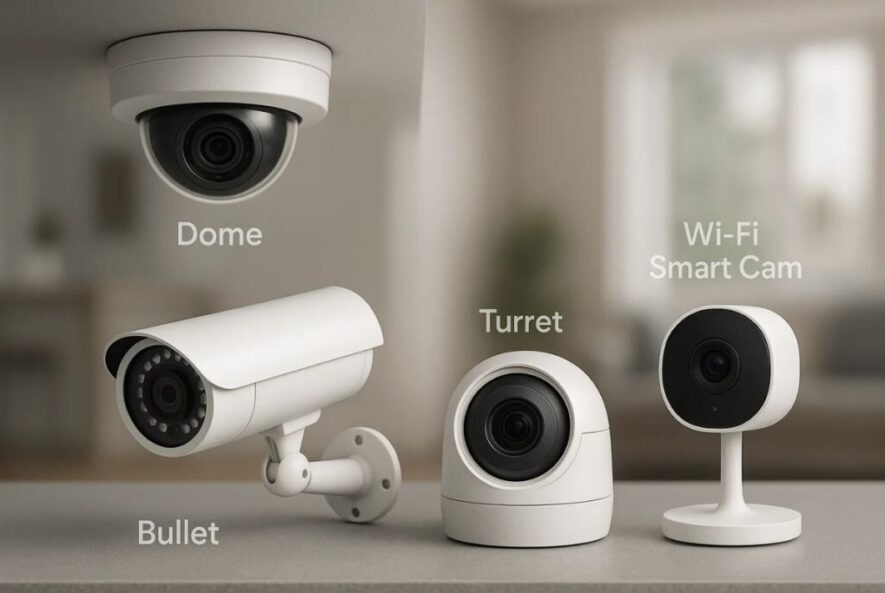
1. Dome CCTV Cameras
Dome cameras have a rounded, dome-shaped housing that makes them easy to recognise. Their compact design makes them a popular choice for indoor and commercial surveillance.
The camera is often mounted on ceilings or walls, allowing it to monitor areas such as entrances, corridors, reception areas, shops, and offices.
Key Benefits
- Compact and discreet design
- Suitable for indoor installations
- Wide viewing options
- Difficult to determine the camera’s viewing direction on some models
- Available with night vision
Best for: Offices, retail stores, hotels, schools, and indoor areas.
2. Bullet CCTV Cameras
Bullet cameras have a long, cylindrical shape and are commonly installed on exterior walls, poles, and other outdoor locations.
Their design makes them particularly suitable for monitoring entrances, driveways, parking areas, boundaries, and other locations where a more focused viewing angle is needed. Many outdoor bullet cameras also come with weather-resistant housings and infrared night vision.
Key Benefits
- Excellent for outdoor monitoring
- Long-range viewing options
- Easy to position toward a specific area
- Often available with strong weather protection
- Suitable for day and night surveillance
Best for: Parking lots, entrances, building perimeters, warehouses, and outdoor spaces.
3. PTZ CCTV Cameras
PTZ stands for Pan, Tilt, and Zoom. These cameras can move horizontally, move vertically, and zoom in on specific objects or areas.
Instead of covering only one fixed direction, a PTZ camera can be controlled to monitor different parts of a large area. Some models also offer automatic tracking and preset viewing positions.
Key Benefits
- Wide-area monitoring
- Remote pan and tilt control
- Optical zoom on many models
- Useful for tracking moving subjects
- Can reduce the number of cameras needed in certain applications
Best for: Large properties, parking areas, warehouses, commercial facilities, and public spaces.
4. Turret CCTV Cameras
Turret cameras are sometimes called eyeball cameras because of their adjustable ball-like design. They combine some of the compact appearance of dome cameras with a flexible viewing angle.
Unlike traditional dome cameras, turret cameras generally do not have a clear dome covering the lens, which can make cleaning and maintenance easier.
Key Benefits
- Flexible positioning
- Good image quality
- Easy to adjust
- Suitable for indoor and outdoor use
- Often available with infrared night vision
Best for: Homes, offices, shops, entrances, and outdoor areas.
5. C-Mount CCTV Cameras
C-Mount cameras have a detachable lens design, allowing different lenses to be used depending on the surveillance requirement.
This makes them useful when you need to change the viewing distance or field of view. Some C-Mount cameras can also be paired with specialised lenses for particular environments.
Key Benefits
- Interchangeable lenses
- Flexible viewing options
- Suitable for specialised surveillance
- Useful for longer-distance monitoring
Best for: Industrial environments, warehouses, manufacturing facilities, and specialised applications.
6. Day/Night CCTV Cameras
Day/night cameras are designed to provide usable footage under changing lighting conditions. They can automatically adjust their operation as the lighting changes throughout the day. Many models use infrared technology or advanced sensors to improve visibility in low-light environments.
Key Benefits
- Suitable for changing lighting conditions
- Better low-light performance
- Available for indoor and outdoor use
- Useful for continuous surveillance
Best for: Outdoor areas, building entrances, parking spaces, and locations with variable lighting.
7. Infrared (IR) CCTV Cameras
IR CCTV cameras use infrared LEDs to capture footage when there is little or no visible light. They are particularly useful when surveillance is required throughout the night. When choosing an IR camera, consider its infrared range and the size of the area you need to monitor.
Key Benefits
- Night-time surveillance
- Useful in poorly lit areas
- Automatic day/night switching on many models
- Suitable for homes and businesses
Best for: Outdoor areas, warehouses, entrances, corridors, and properties requiring 24-hour monitoring.
8. Wireless CCTV Cameras
Wireless CCTV cameras transmit video over a wireless network instead of requiring a traditional video cable between the camera and recorder.
They can be convenient when running cables is difficult, although they still generally require a power source unless designed as battery-powered cameras.
Key Benefits
- Easier installation in some locations
- Flexible camera placement
- Remote viewing options
- Useful for temporary or changing surveillance needs
Best for: Homes, small offices, rental properties, and locations where cable installation is difficult.
9. IP CCTV Cameras
IP, or Internet Protocol, cameras send video over a network. They can connect to an NVR, network infrastructure, or compatible software for recording and monitoring.
Many modern IP cameras offer high-resolution video, remote viewing, motion detection, smart analytics, and other advanced features.
Key Benefits
- High-resolution video options
- Network-based connectivity
- Remote monitoring
- Easy integration with modern surveillance systems
- Advanced smart features on many models
Best for: Homes, offices, businesses, warehouses, and modern security installations.
10. Analog CCTV Cameras
Analog CCTV cameras send video signals to a compatible DVR through coaxial or similar cabling. Although IP systems have become increasingly popular, analog cameras can still be useful when upgrading or expanding an existing CCTV setup without completely replacing the infrastructure.
Key Benefits
- Can work with existing analog systems
- Straightforward installation
- Available in different camera designs
- Suitable for basic surveillance requirements
Best for: Existing CCTV systems, small businesses, homes, and budget-conscious installations.
11. Fisheye CCTV Cameras
Fisheye cameras use an ultra-wide-angle lens to capture a large area. Depending on the model and software, the footage can be corrected or divided into different viewing sections. They can be useful when you need broad coverage from a single camera position.
Key Benefits
- Very wide field of view
- Can monitor large areas
- Reduces blind spots in suitable applications
- Useful for indoor surveillance
Best for: Retail stores, offices, reception areas, halls, and large indoor spaces.
12. Hidden CCTV Cameras
Hidden cameras are designed to be less noticeable and can be installed in objects or discreet locations. Their use is subject to privacy and surveillance laws, which vary by location.
They should always be installed and used responsibly, particularly in workplaces and areas where people have a reasonable expectation of privacy.
Best for: Specific security applications where discreet monitoring is legally appropriate.
13. Varifocal CCTV Cameras
Varifocal cameras feature lenses with adjustable focal lengths. This allows installers to change the camera’s field of view after installation rather than being restricted to one fixed lens setting. They are useful when the exact viewing distance or framing may need adjustment.
Key Benefits
- Adjustable field of view
- Flexible installation
- Useful for different monitoring distances
- Helps achieve more precise framing
Best for: Entrances, commercial properties, warehouses, and areas where camera positioning needs flexibility.
How to Choose the Right Type of CCTV Camera
With so many types of CCTV cameras available, the best choice depends on your property’s specific requirements. Consider these factors before buying:
1. Installation Location
Determine whether the camera will be installed indoors or outdoors. Outdoor cameras should have appropriate protection against weather and environmental conditions.
2. Viewing Distance
For long driveways, boundaries, or large outdoor areas, a camera designed for longer-range viewing may be more appropriate than a standard indoor camera.
3. Lighting Conditions
If the area becomes dark at night, choose a camera with suitable low-light or infrared capabilities.
4. Required Resolution
Higher-resolution cameras can provide more image detail, which may be useful for identifying faces, vehicles, signs, and other important objects.
5. Viewing Angle
A narrow field of view may be suitable for monitoring a doorway, while a wide-angle camera can cover larger areas.
6. Storage and Recording
Consider whether you need a DVR, NVR, local storage, cloud storage, or another recording solution. Make sure your storage capacity matches the number of cameras and recording requirements.
7. Remote Monitoring
If you want to view your cameras from a smartphone or computer while away from the property, choose a system that supports secure remote access.
8. Budget
Don’t choose a camera based only on its price. Consider image quality, durability, storage, installation, maintenance, and features to determine the overall value.
FAQs
1. What are the most common types of CCTV cameras?
Dome, bullet, turret, PTZ, IP, wireless, infrared, and analog cameras are among the most common options.
2. Which CCTV camera is best for outdoor use?
Bullet, turret, and suitable outdoor-rated PTZ cameras are popular choices for outdoor surveillance.
3. Which CCTV camera is best for night vision?
Infrared and suitable day/night cameras can provide effective surveillance in low-light or dark conditions.
4. Are IP cameras better than analog CCTV cameras?
IP cameras generally offer modern network features and high-resolution options, while analog cameras can be practical for existing systems.
5. What is the difference between dome and bullet cameras?
Dome cameras have a compact, rounded design, while bullet cameras are cylindrical and are commonly used for focused outdoor monitoring.
6. Are wireless CCTV cameras completely cable-free?
Not always. Many wireless cameras still require a power connection even though they transmit video wirelessly.
7. What type of CCTV camera is best for a large area?
PTZ and wide-angle cameras can be suitable for large areas, depending on the property’s layout and required coverage.
8. Can one CCTV camera cover a large area?
Some wide-angle and PTZ cameras can cover large areas, but multiple cameras may provide better coverage and fewer blind spots.
Final Thoughts
Choosing between different types of CCTV cameras becomes much easier when you understand what each camera is designed to do. Dome cameras are excellent for discreet indoor monitoring, bullet cameras work well outdoors, PTZ cameras are useful for large areas, while IP cameras offer modern network-based surveillance features.
Before installing a CCTV system, consider your property’s layout, lighting, coverage requirements, viewing distance, storage needs, and budget. Choosing the right camera for each location can help reduce blind spots and create a more effective security system.